
En este número:
Cómo una protesta triunfa antes de ganar - Lo que vi en la protesta Stop the AI Race de San Francisco
Los empleados de IA se están convirtiendo en grandes donantes políticos - Sus donaciones sugieren dudas sobre hacia dónde nos lleva la industria de la IA
Publicación invitada de Haven Harms
Cómo una protesta triunfa antes de ganar
Lo que vi en la protesta Stop the AI Race de San Francisco
"¡Uno, dos, tres, cuatro, no queremos guerra de robots!"
El sábado 11 de julio, cientos de nosotros marchamos por San Francisco en la protesta Stop the AI Race, y nos concentramos frente a las oficinas de OpenAI, Anthropic y Google DeepMind. Nuestra única exigencia: que todos los directores ejecutivos de los grandes laboratorios de IA se comprometan públicamente a pausar el desarrollo de modelos de frontera si todos los demás laboratorios importantes del mundo hacen lo mismo de forma creíble. La estructura condicional es justamente el punto: a ningún director ejecutivo se le pide que se detenga solo. A cada uno se le pide únicamente que diga, en efecto: "Si los demás pausan, yo también".
El lema de la protesta era "Freeze AI" (congelen la IA), un juego con el más usado "Pause AI" (pausen la IA) y un guiño travieso a la fecha: 11 de julio, o sea 7/11, o sea el Día del Slurpee. ¿Fue exitosa la protesta?
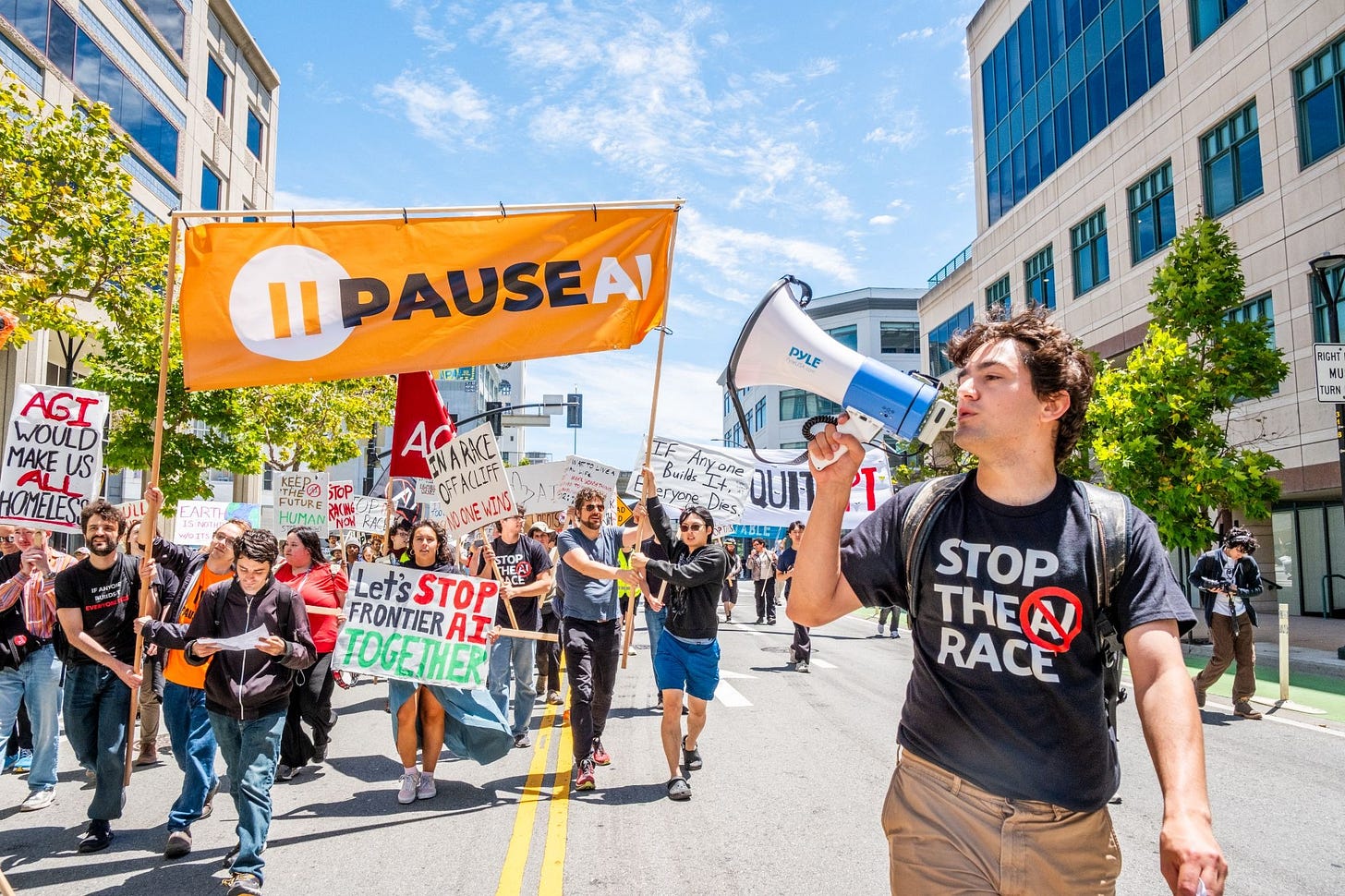
Crédito: Camille Elize Cohen
Hasta donde yo sé, ninguno de los directores ejecutivos de los laboratorios de IA se ha comprometido públicamente todavía a una pausa condicional del desarrollo de IA de frontera. Sin embargo, las exigencias de una protesta rara vez se cumplen de un día para otro. Ganar la exigencia declarada es solo la medida más visible del éxito de una protesta. Las protestas también construyen el movimiento, amplifican los mensajes y cambian el terreno político. Todo esto hace que el éxito sea más probable con el tiempo. Mientras marchaba por San Francisco el sábado, vi algunos de estos mecanismos en acción.
Las protestas construyen el movimiento
"¡Cinco, seis, siete, ocho, no al Estado de vigilancia con IA!"
El primer mecanismo es la construcción del movimiento: una protesta reúne a la gente, atrae a nuevos participantes y ayuda a convertir una coalición dispersa en algo duradero. Como una bola de nieve que rueda cuesta abajo, el movimiento gana impulso y se vuelve más fácil de integrar a medida que crece.
Al comienzo de la protesta, Michaël Trazzi, el organizador principal de la marcha, nos pidió a todos que dedicáramos un minuto a hablar con alguien nuevo y averiguar por qué estaba allí. Conversé con la persona que tenía al lado y me enteré de que había viajado desde Londres para participar en la marcha. Mencionó que era parte del grupo PauseAI y que fue una de las primeras personas en protestar frente a Google DeepMind allá por 2023. "Ah, guau, cuando aparecían solo unas diez personas. Es una diferencia bastante grande respecto a hoy", le dije, impresionada.
"Bueno, en realidad probablemente eran más bien cinco personas", me corrigió. Touché.
Es mucho más fácil protestar entre cientos de personas que entre cinco. Una de las cosas más llamativas de ese sábado fue que este ya no es un movimiento formado únicamente por gente del mundo de la seguridad en IA. Es una coalición de personas de distintos orígenes cuyas preocupaciones sobre la IA convergen en una exigencia compartida: crear tiempo para atender los riesgos y daños que temen antes de que el desarrollo de IA avanzada siga adelante. Algunos querían deshacerse por completo de la IA; otros eran usuarios entusiastas de las herramientas de IA actuales, pero les preocupaba el rumbo del desarrollo de IA avanzada. La gente llegó preocupada por el empleo, la vigilancia masiva, el daño ambiental, el riesgo de extinción y el futuro de sus hijos. Pese a nuestras distintas preocupaciones, compartíamos la creencia de que desarrollar sistemas que superen nuestra capacidad de control podría tener consecuencias irreversibles, y de que ir más despacio preserva nuestra posibilidad de evitarlas.
Marchar junto a personas con las que en otro contexto podrías estar discutiendo puede generar confianza y convertir una coalición amplia en un movimiento más duradero. A medida que esa coalición se extiende más allá de la comunidad tradicional de seguridad en IA, el movimiento tiene más espacio para crecer.
Las protestas amplifican el mensaje
"¡Frenen ya y bajen el paso, no queremos carrera de IA!"
El segundo mecanismo es la amplificación. La cobertura noticiosa y las redes sociales convierten una marcha local en una historia que puede llegar mucho más lejos que las personas que asistieron.
Había fotógrafos tomando imágenes y gente parada a lo largo de la calle grabándonos con sus teléfonos. En los días transcurridos desde entonces han ido apareciendo artículos y publicaciones en redes sociales. Para alguien que no ha pensado mucho en el tema, ver a una multitud en las calles despierta curiosidad. "Esta gente está dedicando parte de su día a esto. Quizá tengan razón en algo".
Para quien ya está de acuerdo, rompe la ilusión de aislamiento. Es una sensación terrible reconocer la magnitud de un problema y pensar: "¿Pero qué puedo hacer yo al respecto? Soy una sola persona". Una protesta puede ofrecer pruebas que cambian ese pensamiento a: "No soy la única, y protestar es algo que realmente puedo hacer".
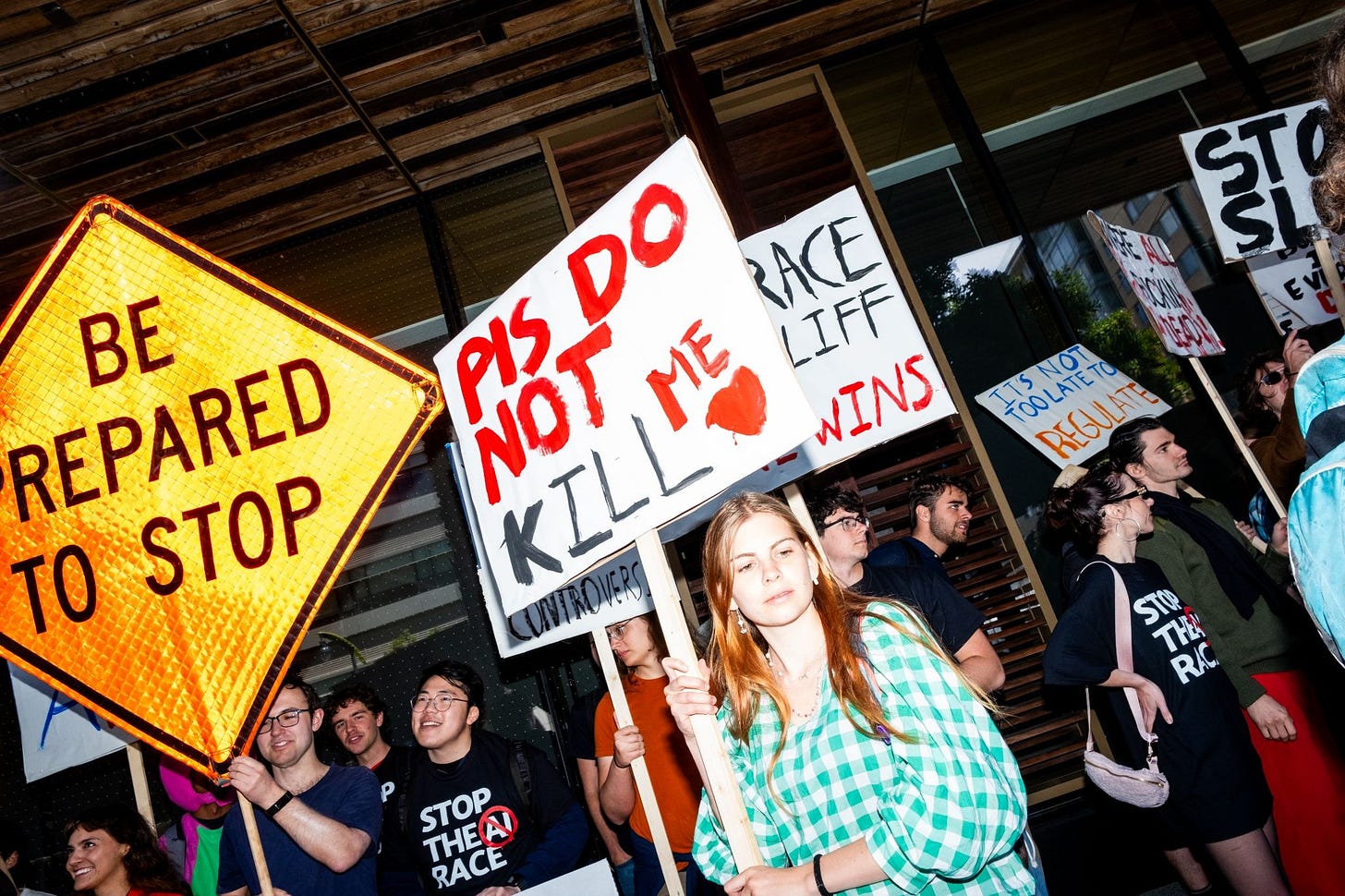
Crédito: Camille Elize Cohen
A medida que las protestas crecen, pueden atraer la atención de políticos, periodistas y líderes de la industria, y hacer que les resulte más difícil ignorar el asunto. El público observa a los líderes para ver cómo responderán. ¿Descartarán una petición razonable? ¿Qué dice eso sobre sus intenciones?
Las protestas cambian el terreno político
"¡Aún se puede regular, no tenemos que automatizar!"
El último mecanismo es el más difícil de ver el día mismo.
Una multitud en las calles señala que un asunto merece atención pública y puede ampliar el rango de posturas que se consideran legítimas. Al poner a cientos de personas en la calle, la marcha Stop the AI Race ayuda a mover el "quizá no deberíamos competir para construir esto" desde un debate de iniciados hasta una pregunta pública legítima. Para muchos manifestantes, sobre todo quienes creen que la IA avanzada podría causar la extinción humana, un alto no es una posición de negociación sino la respuesta mínima adecuada. Sin embargo, una vez que la idea de pausar el desarrollo de la IA entra en el debate público, políticas más acotadas como las pruebas de seguridad obligatorias o los requisitos de transparencia pueden parecer más moderadas en comparación y, por lo tanto, más probables de adoptarse. A su vez, esas medidas pueden construir la supervisión, los mecanismos de aplicación y el precedente para regular el desarrollo de la IA que hacen que implementar y hacer cumplir una pausa global sea más viable y, en última instancia, más probable.
Una marcha también le da a los aliados dentro de las instituciones algo a lo que apuntar: el legislador que redacta un proyecto de ley sobre IA, o el empleado de un laboratorio que se opone internamente, ahora cuenta con evidencia visible de demanda pública detrás de posturas que ya sostenía. Un director ejecutivo todavía puede desentenderse de los compromisos de seguridad, y un político todavía puede mirar hacia otro lado, pero la oposición pública visible encarece esas decisiones en términos políticos y de reputación.
¿Por qué la banda de música? ¿Fuimos "demasiado poco serios"?
"¡Paren la locura, no extingan a la humanidad!"
Una de las críticas a la protesta que vi en internet fue "el ambiente es demasiado poco serio" y "si de verdad creen que la IA va a matar a todo el mundo, ¿por qué están bailando con una banda de música?".
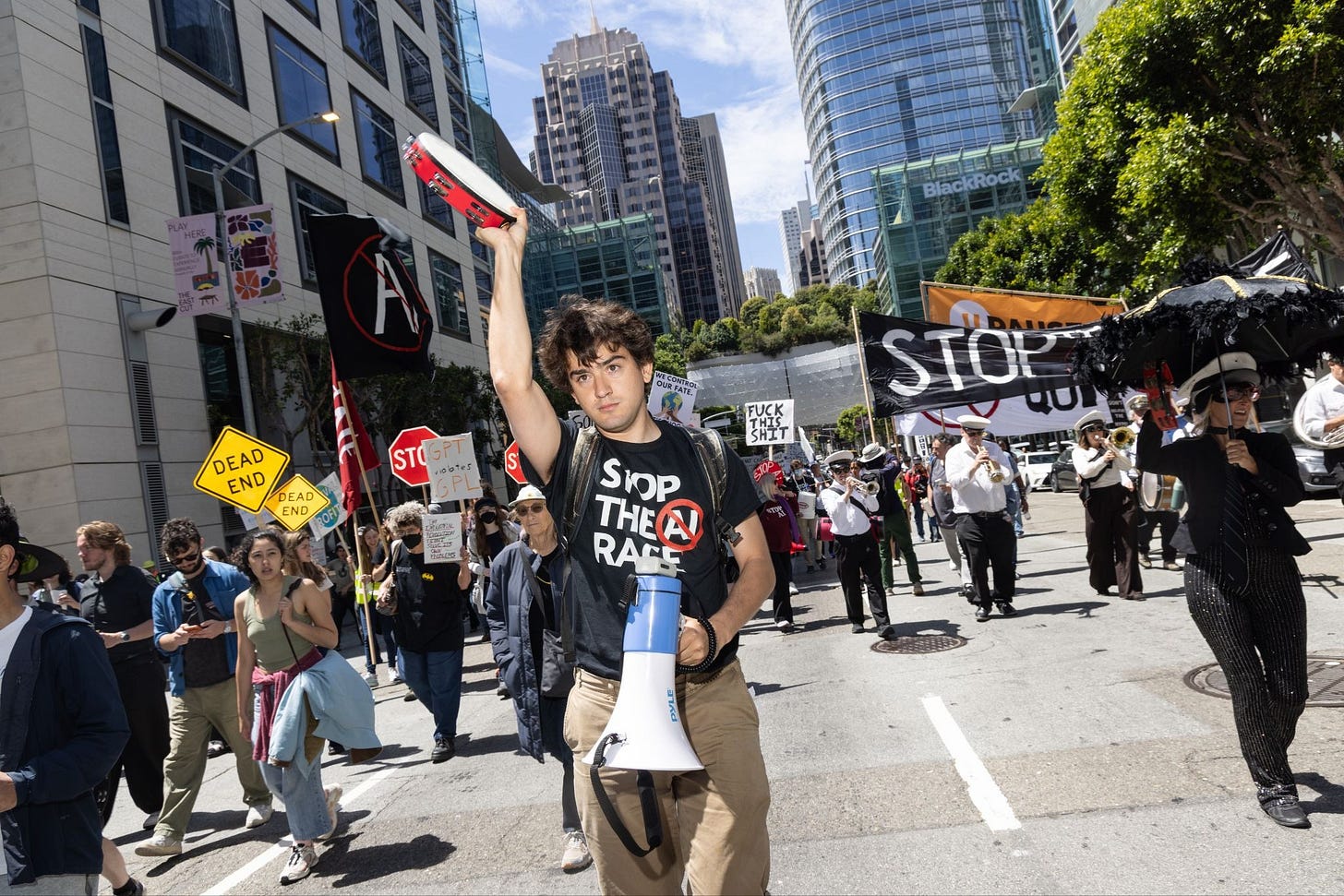
Crédito: Rachel Bujalski
La banda de metales St. Gabriel's Celestial Brass Band hizo que la marcha fuera divertida y mantuvo alta la moral, sobre todo cuando las ráfagas de viento constantes dificultaban sostener los carteles grandes. La música animada quizá también ayudó a mantener un ambiente ligero y pacífico, en línea con el enfoque explícitamente no violento de Stop the AI Race. Tal vez más protestas deberían tener bandas de música con ritmo.
El baile y la música fueron solo una parte de la protesta, pero la crítica también pasa por alto un cambio más amplio en el movimiento de seguridad en IA. Hace unos años, la situación parecía extremadamente sombría. ¿Cómo íbamos a despertar al mundo sobre lo que estaba ocurriendo? Muchas personas que conocía en el ámbito de la seguridad en IA pasaron tiempo lamentando un futuro que temían que ya estuviera perdido. Más recientemente, he visto cómo parte de ese duelo se convertía en determinación y acción.
Ese cambio no se basa solo en el ánimo interno; la conversación pública y política también ha cambiado. Hace menos de un año se publicó el libro If Anyone Builds It, Everyone Dies. Desde entonces, el senador Bernie Sanders ha convocado un panel sobre los riesgos existenciales de la IA que incluyó a científicos estadounidenses y chinos, mientras que divulgadores científicos destacados como Neil deGrasse Tyson han pedido un tratado global contra la superinteligencia letal. Según el rastreador de la AI Policy Network, 40 miembros actuales del Congreso (19 republicanos, 21 demócratas) han reconocido públicamente los riesgos de la IA avanzada. Así que sí, aunque a la gente de seguridad en IA todavía suelen llamarla "doomers" (agoreros), la situación ya no se siente desesperanzada. Todavía hay trabajo por hacer, pero marchamos con esa esperanza viva por dentro.
¿Qué sigue?
"¡Por nuestro futuro, alto a la carrera!"
Mientras la multitud se reunía frente a Anthropic, Trazzi dejó claro que esta protesta no era el final. La sensación general era que estábamos haciendo algo bueno, pero también que era sábado, cuando hay pocos empleados dentro de los laboratorios. Trazzi anunció que las próximas protestas se realizarían entre semana, cuando podrían golpear más fuerte, y pidió a la gente que levantara la mano si iba a estar allí. Las manos se alzaron por toda la multitud.
Cuando terminó la marcha, nos reunimos en Rincon Park. La banda siguió tocando y comimos pizza. Amigos nuevos y viejos se mezclaron, celebrando lo que habíamos logrado. Me senté en un borde del paseo junto al agua y miré hacia el puente de la Bahía, con nuestros carteles todavía apoyados a nuestro alrededor, visibles para cualquiera que pasara. En un momento, un mar de gente atravesó el parque, porque acababa de terminar el partido de los Giants.
"¿Están protestando contra la IA?", le dijo una joven aficionada de los Giants a sus amigos. "¡Eso sí que me gusta!"
Quizá se sume a la próxima protesta. Ustedes también pueden hacerlo: la próxima protesta de Stop the AI Race está prevista para el lunes 20 de julio de 2026. Entren a stoptherace.ai para inscribirse y recibir novedades.
Una iniciativa aparte, la marcha Don't Build It, también está reuniendo compromisos de asistencia para una manifestación planeada en Washington, DC. Es la que está vinculada al libro If Anyone Builds It, Everyone Dies, y pide a los líderes mundiales que detengan la carrera hacia la superinteligencia mediante un tratado internacional. No hay fecha fijada: los organizadores planean convocar la marcha una vez que 100,000 personas se hayan comprometido a asistir. Pueden comprometerse o inscribirse para recibir novedades en ifanyonebuildsit.com/march.
Haven Harms es fundadora y responsable principal de Harms Research & Consulting, que apoya a organizaciones que trabajan en seguridad, gobernanza y promoción en materia de IA.
Despacho de Mitch
Los empleados de IA se están convirtiendo en grandes donantes políticos
Sus donaciones sugieren dudas sobre hacia dónde nos lleva la industria de la IA

Rueda dentada y rueda de mortaja con dientes. Crédito: Tangopaso .
Creo firmemente que casi todas las personas que trabajan en las grandes empresas de IA tienen buenas intenciones.
Por desgracia, tener buenas intenciones y hacer el bien no son lo mismo. A través de la racionalización, el interés propio tiene la costumbre de secuestrar las buenas intenciones.
No hablo solo de los efectos que alteran la mente de los paquetes de compensación de siete a nueve cifras, porque el interés propio no es puramente monetario. Algunas personas en estas empresas están siguiendo su curiosidad. Otras solo quieren seguir haciendo aquello en lo que son buenas, o estar en el centro de algo importante. Pero para muchas, sospecho que los incentivos más fuertes son sociales: si has estado metido de lleno en tu empresa, desarrollando IA durante años, la industria podría ser todo tu mundo. Tus amistades, tu prestigio profesional y tu sentido de autoestima podrían estar todos ligados a creencias de grupo sobre que la superinteligencia es a la vez inevitable y demasiado poderosa como para dejarla en manos de otro grupo.
Imagino que la dificultad de salir de ese mundo no es muy distinta de la dificultad de abandonar una religión que consume socialmente (un asunto sobre el que puedo hablar por experiencia personal).
Así es como concilio la aparente contradicción en las expresiones políticas que vemos de parte de estos empleados. El San Francisco Standard es el medio más reciente en informar que trabajadores de IA beneficiados por salidas a bolsa o rondas de inversión recientes o esperadas están haciendo donaciones políticas considerables a candidatos y súper PAC que impulsan una regulación más estricta de la industria de la IA.
La tasa de contribución se describe como inusual:
Las donaciones políticas solían ser poco frecuentes entre los trabajadores tecnológicos (célebremente apolíticos), pero están mucho más extendidas en las empresas de IA, en particular en Anthropic. Aproximadamente 59 de cada 1,000 empleados de Anthropic han donado a una campaña federal en este ciclo, casi el triple de la tasa de los empleados de Airbnb durante su primer ciclo tras la salida a bolsa, y cinco o seis veces la de Facebook y Google. La tasa de participación de donantes de OpenAI es menor, pero aun así supera a las cohortes posteriores a la salida a bolsa de Google, Facebook y Airbnb.
Como siempre, se puede encontrar una lectura cínica: quizá estos donantes esperan influir en los reguladores antes de que los reguladores puedan influir en ellos. Pero no me lo creo. Esa clase de jugada requiere coordinación de alto nivel, que parece ausente. Las donaciones individuales en muchos casos contrarrestan directamente las donaciones antirregulación de un número menor de figuras destacadas de sus propias empresas, como las del presidente de OpenAI, Greg Brockman.
Hay una explicación no cínica. El artículo atribuye, creo que razonablemente, la mayor tasa de donaciones de los trabajadores tecnológicos de IA a las normas del Altruismo Eficaz, una filosofía de la caridad popular entre muchos de quienes fueron a trabajar a estas empresas. El Altruismo Eficaz respalda las estrategias de "earning to give" (ganar para donar), en las que una persona talentosa podría ir a trabajar a un campo bien pagado para poder donar grandes sumas a causas que se espera que hagan mucho más bien con ese dinero que los daños incidentales derivados de haberlo ganado.
Así que sospecho que muchos empleados de IA que ahora donan grandes sumas a la política de seguridad en IA se ven a sí mismos como fieles a sus principios mientras intentan influir positivamente en sus empresas, sobre las que tienen serias dudas, desde dentro. Algunos de sus terapeutas lo confirman, según un artículo que cubrí en abril.
Para ser justos, personalmente asigno una probabilidad de un solo dígito porcentual a que la estrategia del infiltrado concienzudo sea correcta, más o menos tan alta como la probabilidad que las personas que siguen esa estrategia suelen asignar a que la superinteligencia acabe con la humanidad.
Pero mi colega Alana compartió hace poco por qué intentar hacer el bien desde dentro de los laboratorios de IA parece un plan fatalmente defectuoso. El jueves, ella comentó una entrada de blog del exempleado de Google DeepMind Alex Turner sobre cómo la gente de estas empresas ya ha demostrado una y otra vez que, a la hora de la verdad, ignora las líneas rojas que se ha fijado a sí misma.
La humildad consiste en admitir que tu valentía puede fallar y que tu brújula moral puede torcerse. La sabiduría consiste en salir de un entorno moralmente corrosivo mientras todavía puedes. Las donaciones a la seguridad en IA que se filtran desde la maquinaria de la industria me dicen que partes de esa maquinaria tienen buenas intenciones. Pero un engranaje que chirría en señal de protesta sigue siendo un engranaje.
Los análisis y las opiniones expresadas en AI StopWatch reflejan los puntos de vista de los colaboradores individuales y de las fuentes que cubren, y no deben tomarse como posiciones oficiales del Machine Intelligence Research Institute.